Boboli Gardens: Tickets, Hours and the Paths Through It
The garden behind Palazzo Pitti: 2026 prices and passes, the hours month by month, the Mondays it closes, the free days, what stands where on the hillside and what is under restoration, and the guided tour that pairs it with the Palatine Gallery.
A Boboli Gardens ticket costs €10 bought on the day or €13 bought in advance in 2026, and €22 (€25 in advance) together with Palazzo Pitti. The garden opens at 8:15 am every day except the first and last Monday of each month and 25 December, and closes at times that run from 4:30 pm in winter to 7:10 pm in summer, with the last entry an hour before closing. Palazzo Pitti, the palace in front of it, is closed every Monday. Under-18s go in free, and so does everyone on the first Sunday of the month.
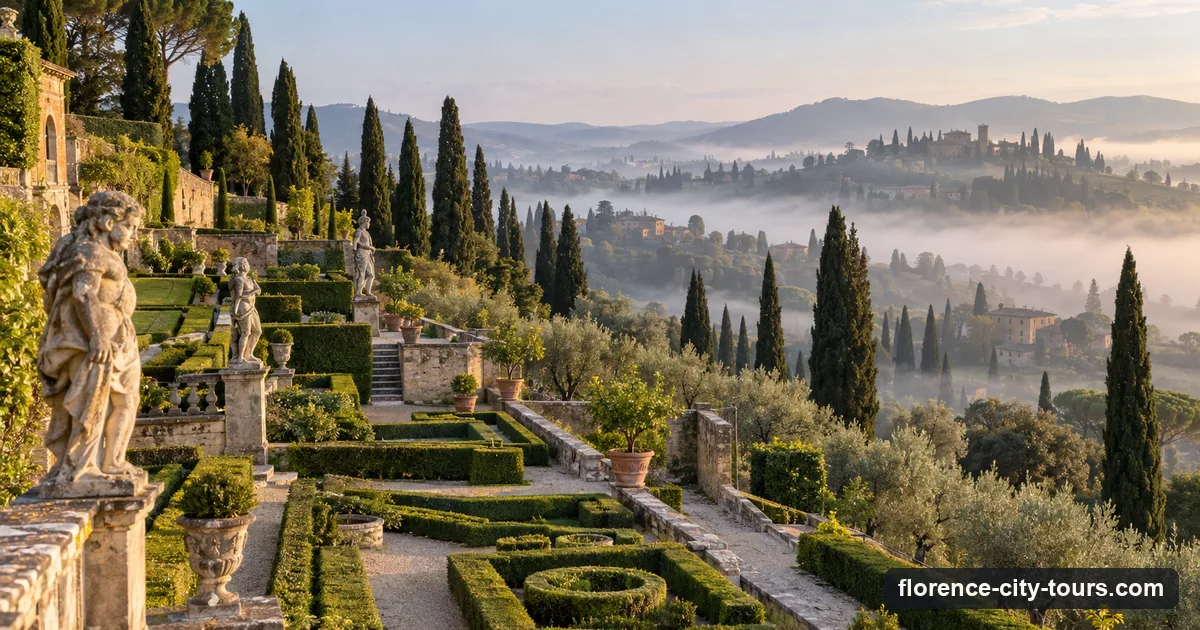
The Uffizi, which runs both, calls the garden an integral part of the Pitti visit. If you want the two explained, the calendar below is FLORENCEPASS’s “Florence: Pitti Palace, Boboli Garden, Palatine Gallery Tour”, with a licensed guide and timed entry to Pitti Palace, the Palatine Gallery and the Boboli Garden included. The listing’s route starts in the palace courtyard, climbs to the Palatine Gallery on the first floor, where it names paintings by Andrea del Sarto, Raphael, Titian, Rubens, Van Dyck and Caravaggio, and goes on into the oldest part of the garden around the Amphitheatre. It meets at Piazza Pitti 1, the palace’s main entrance, in the early morning or early afternoon. From 1 July to 31 August the 2:00 pm tour stays indoors and adds the Royal Apartments, and the garden is yours to explore afterwards.
It costs from $110 as of October 2026 and is rated 4.8 from 656 reviews, with free cancellation up to 24 hours before. Lunch and gratuities are not included; wear comfortable shoes for the garden.
Boboli Gardens tickets and passes in 2026
| Ticket | Bought on the day | Bought in advance |
|---|---|---|
| Boboli Gardens | €10 | €13 |
| Palazzo Pitti and Boboli together | €22 | €25 |
| Palazzo Pitti alone | €16 | €19 |
| Boboli and the Bardini Gardens | €15, at the ticket offices | not sold online |
| PassePartout 5 Days: the Uffizi, Palazzo Pitti and Boboli | €40 | |
| Boboli annual pass | €25 |
Tickets carry your name, and the €3 difference between the two columns is the advance-booking fee, charged on full-price tickets only. The Boboli and Bardini ticket, sold since 3 March 2026, is the exception: it is not named, it is sold only on the day at the Uffizi Galleries’ ticket offices, and not on days when Boboli is closed or free. From 25 October 2026 to 28 February 2027 its sales stop at 1:45 pm. EU citizens aged 18 to 25 pay a reduced price, for which the museum’s pages give two different figures. The Firenze Card, €85 for 72 hours, covers Palazzo Pitti and Boboli; card holders first collect a ticket in the palace’s Ammannati courtyard.
Can you go to the Boboli Gardens for free?
Yes, in two ways. Under-18s of any nationality go in free, as at all state museums, and everyone goes in free on the first Sunday of the month and on 25 April, 2 June and 4 November. On those free days nothing is sold in advance: you collect a free ticket at the entrance.
Do you need to book?
No. The cheapest ticket is the one bought on the day, at the ticket office in the square in front of Palazzo Pitti or at the garden’s entrances; buying ahead costs €3 more. The exception inside the palace is the Royal Apartments, whose tours must be booked, online when you buy your ticket or at the ticket office on the day, and online only on free Sundays.
Opening hours, month by month
| Months | The garden closes at |
|---|---|
| January, February, November, December | 4:30 pm |
| March and October, on standard time | 5:30 pm |
| March and October on daylight saving time, April, May, September | 6:30 pm |
| June, July, August | 7:10 pm |
The garden opens at 8:15 am, and the last entry is always an hour before closing. It is closed on the first and last Monday of each month and on 25 December, and the Uffizi warns that weather emergencies can close it or change its hours at short notice.
Palazzo Pitti keeps different days: Tuesday to Sunday, 8:15 am to 6:30 pm, closed on Mondays, 1 January and 25 December, with the ticket office closing an hour before the museum.
The paths: what stands where
The garden climbs the hillside behind Palazzo Pitti. Tribolo laid it out from 1549 for Duchess Eleonora of Toledo, geometric and symmetrical. The Uffizi calls it one of the most important examples of an Italian garden and credits the Medici with creating the Italian garden style “that would become a model for many European courts”. Cosimo II and Ferdinando II enlarged it to the south, and the Lorraine and Savoy rulers later extended it along the old city walls as far as Porta Romana. Its main places, as the Uffizi describes them:
- The Amphitheatre, behind the palace, began as the quarry that supplied the palace’s stone. Tribolo designed it as an “amphitheatre of greenery”, built in 1550 after his death, and Giulio Parigi rebuilt it in masonry between 1630 and 1634. The Egyptian obelisk and the red granite basin in the middle came from the Medici collections in Rome.
- The Buontalenti Grotto, built from 1583 to 1593 by Bernardo Buontalenti in place of a nursery designed by Vasari, with stalactites, shells and water running down its walls. Groups leaving the Vasari Corridor come out through a door next to it. The Grotto of Madama, from 1553 to 1555, was one of the garden’s first buildings.
- The Statue of Abundance, begun by Giambologna and finished by Pietro Tacca, which in the Uffizi’s words “dominates the whole complex from above”, and the Fountain of Neptune.
- The Kaffeehaus, an 18th-century pavilion on the hillside that the Uffizi calls “a rare example of Rococo architecture in Tuscany”, and the Lemon House, built by Zanobi del Rosso in 1777 and 1778 for the Medici’s citrus trees.
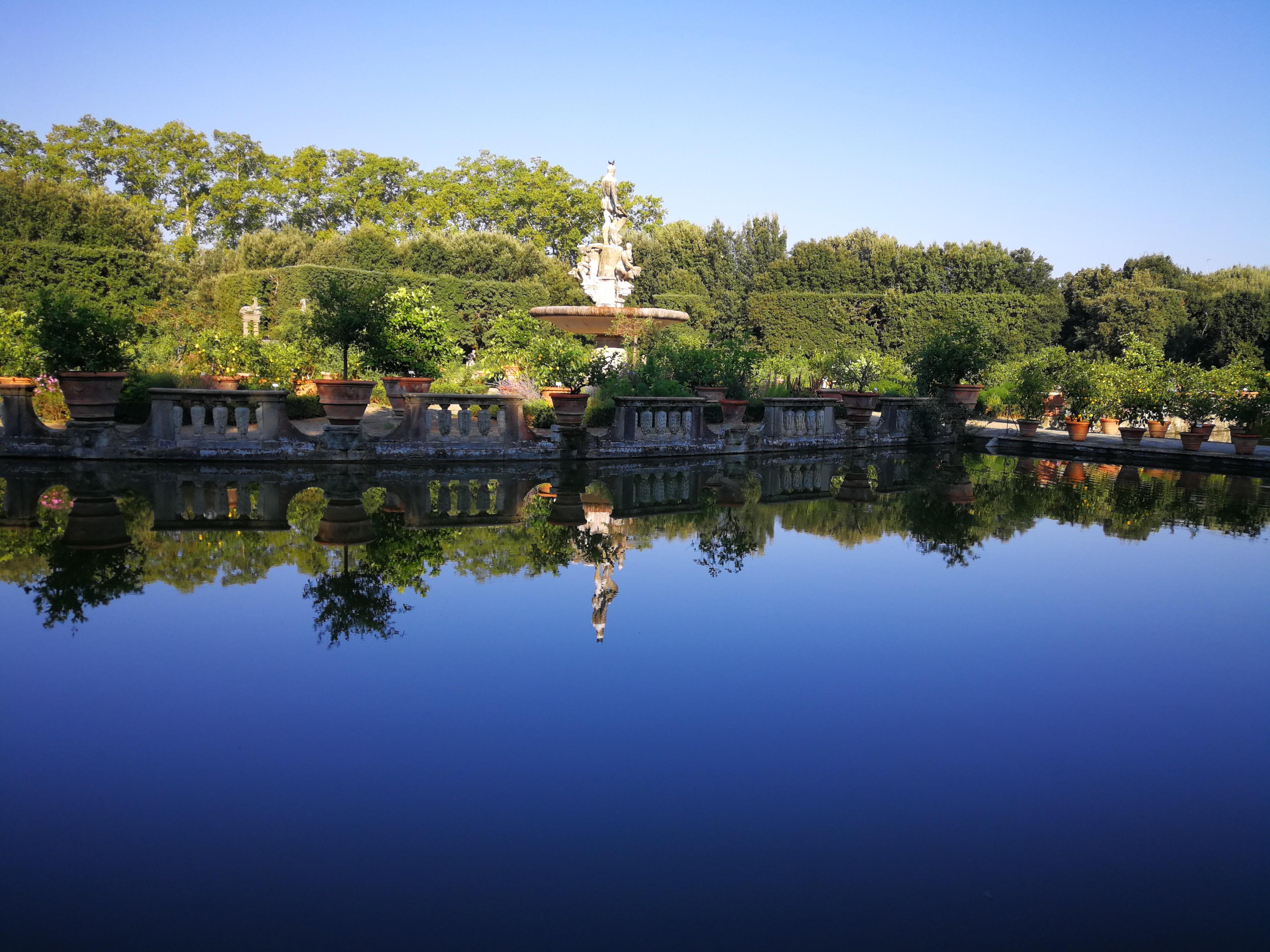
- The Viottolone, the wide avenue of the southern extension, at the end of which Alfonso Parigi designed an elliptical basin around an island, with Giambologna’s Ocean at its centre.
- The Porcelain Museum, closed for refurbishment until further notice.
Some of it is closed off. The Uffizi’s list of areas under restoration, as read in October 2026, takes in the Princes Garden, the Fountain of Neptune, the Amphitheatre’s stands, the Chestnut Meadow, the gates to the Lower Botanical Garden and the Lemon House, part of the Upper Labyrinth along the Cypress Lane, the inner area of the Island basin, and the museum. You cannot go into those areas, but the Uffizi says most of them remain visible, and the ramp up to the Kaffeehaus from the Forte di Belvedere entrance is open.
There are four ways in and out: through Palazzo Pitti, the Annalena entrance on Via Romana, the Forte di Belvedere gate and the Porta Romana gate. You do not have to walk back to where you started.
How long does Boboli take?
The Uffizi publishes no visit time, so we will not invent one. What it does say shapes the answer. The ground is mostly clay and gravel and “almost completely sloping, with climbs and descents”, and the gardens are big enough that the museum recommends carrying water on hot days. Drinking fountains are near the Garden of Madama, the Knight’s Garden, the Grotto of Adam and Eve and the Meadow of the Columns. Last entry is an hour before closing, and the four gates mean a walk can end at the far side.
Toilets are at the Annalena entrance, near the Amphitheatre and near the Garden of the “Hair Washer” statue, and the cloakroom on the right of the Ammannati courtyard is free. Two entrances are accessible to wheelchair users, from Piazza Pitti (on the left side of the courtyard) and from Piazza di Porta Romana, and the Uffizi says the garden is accessible only with a companion.
Is the Pitti Palace worth visiting, and is it free?
It is not free outside the free days: Palazzo Pitti costs €16 on the day or €19 in advance in 2026, with under-18s free. One ticket covers all its collections: the Palatine Gallery, the Gallery of Modern Art, the Museum of Costume and Fashion, the Museum of Russian Icons, the Palatine Chapel and the Treasury of the Grand Dukes. The Treasury has been closed since 3 February 2026, the Palatine Gallery’s Room of the Iliad is closed until 25 October 2026, and the Quartiere del Volterrano rooms remain closed. The Royal Apartments are shown on tours of about 30 minutes, every half hour from 10 am to 5 pm for up to 20 people, at no extra cost on a Pitti ticket, booked for the same day as your Palatine Gallery visit.
Whether it is worth it depends on what you came for. The Uffizi calls the icons the oldest collection of Russian icons in Western Europe, and the city’s tourism site calls the costume museum the most important of its kind in Italy. The palace was begun in the mid-1400s by the banker Luca Pitti, “maybe after a design by Brunelleschi”, and after its purchase in 1550 Cosimo I de’ Medici and Eleonora of Toledo chose it as their new grand-ducal residence.
Pitti and Boboli on the same day?
You do not have to. Separate tickets let you split them, the PassePartout spreads the Uffizi, Palazzo Pitti and Boboli across five consecutive days, and Firenze Card holders keep their Pitti ticket for the rest of the card’s 72 hours. The combined ticket is the cheapest way into both: €22 on the day against €26 for the two bought separately, or €25 in advance against €32.
Uffizi or Accademia?
They hold different things, so it depends what you came for. The Accademia is where Michelangelo’s David stands, 517 cm tall with its carved base; entry costs €20 plus a €4 booking fee in 2026. The Uffizi is the painting gallery, which the city’s tourism site calls the most visited in Italy, at €25 on the day or €29 in advance. Both close on Mondays. The David and Accademia and Uffizi pages compare the tickets and the guided visits for each.
From the Uffizi, over the river
The Vasari Corridor ends here. Groups come out by the Buontalenti Grotto and are walked to the Ammannati courtyard; with a Boboli or Pitti ticket you carry on, and without one you leave. The Uffizi will not sell a Boboli ticket in the same purchase as a corridor slot that ends less than an hour and a half before the garden closes. How to visit the Vasari Corridor covers the corridor’s tickets and timing, and on foot the garden lies across Ponte Vecchio from the Uffizi.
Sources: the Gallerie degli Uffizi (Boboli Gardens, Pitti Palace, ticket, history and notice pages), Firenzecard, the Ministero della Cultura, the Galleria dell’Accademia di Firenze and the Comune di Firenze’s tourism site; tour details from the listing. Checked October 2026.
Book the Pitti Palace and Boboli Garden Tour
FLORENCEPASS's guided visit with a licensed guide, with timed entry to Pitti Palace, the Palatine Gallery and the Boboli Garden included, and earsets for groups of four or more. It meets at Piazza Pitti 1, the palace's main entrance, in the early morning or early afternoon; lunch and gratuities are not included. From 1 July to 31 August the 2:00 pm tour stays indoors and adds the Royal Apartments, with the garden on your own afterwards. Palazzo Pitti is closed on Mondays. From $110 as of October 2026, rated 4.8 from 656 reviews, with free cancellation up to 24 hours before.
Check Availability & Book