Ponte Vecchio: The Bridge, Its Shops and the Corridor Above
The bridge of goldsmiths' shops over the Arno, free to walk across: why it is famous, how it came through 1944, the rule that keeps it for jewellers, what the marks on gold mean, the corridor overhead, and how walks, bikes, carts and boats meet it.
Ponte Vecchio is Italian for “old bridge”: the bridge of goldsmiths’ shops across the Arno in the middle of Florence, and it costs nothing to walk over. The city’s tourism site dates it to 1345, “probably designed by Taddeo Gaddi”, and says it is essentially the bridge you see today. Goldsmiths took over its workshops from the butchers and fishmongers in 1593, the Vasari Corridor has run above them since 1565, and in August 1944 it was the only bridge in Florence left intact during the Nazi retreat.
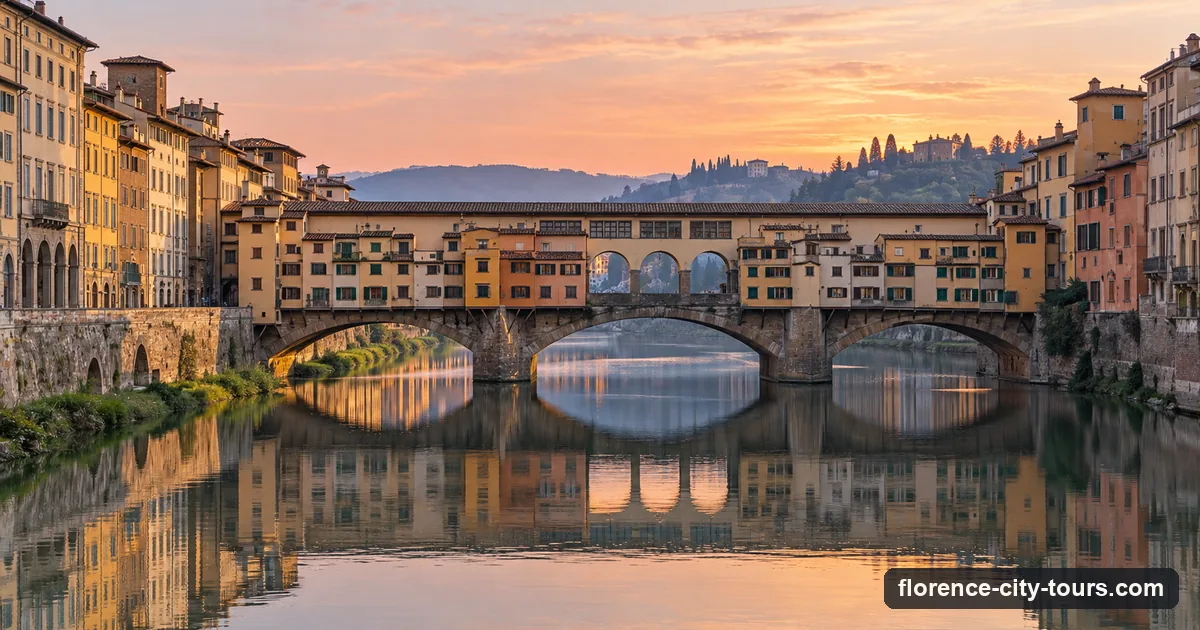
There is no ticket and nothing to book. What there is to plan is how you meet it: on a walk that ends there, from the corridor above it, from a boat on the Arno, or on your own at a quiet time of year. This page covers each, along with the rules that apply on the bridge.
Why is Ponte Vecchio so famous?
Mostly for what sits on it. The goldsmiths’ workshops make it, in the city’s words, the “most precious bridge in the world”. Above them runs the Vasari Corridor, built by Giorgio Vasari in 1565 for Cosimo I de’ Medici, the passage that let the Medici move between Palazzo Vecchio and Palazzo Pitti by way of the Uffizi. At the centre of the bridge stands a monument to Benvenuto Cellini, the sculptor of the Perseus in the Loggia dei Lanzi, made by Raffaello Romanelli in 1900, beside the remains of a 14th-century sundial.
The city’s site also points to the views from the bridge: along the Arno and its other bridges, over the city and out to the surrounding hills.
Which river does it cross, and why was it not destroyed?
It crosses the Arno, with the Uffizi on one bank and the Oltrarno, the district across the river, on the other.
The city’s account of 1944 is brief. In August of that year, during the Nazi retreat, Ponte Vecchio was the only Florentine bridge that remained intact. The flood of 1966 caused serious damage but did not compromise its structure. The city’s page records that it survived, not why.
The shops, and the rule that keeps them
Goldsmiths have worked on the bridge since 1593. The Comune keeps it that way: its regulation for the historic centre, extended in April 2026 to run until 2031, allows only the trade in precious goods on Ponte Vecchio (jewellery, watches, works of art and antiques) and bans serving food or drink there. Nothing is served on the bridge itself.
Is the gold on Ponte Vecchio real?
The rule limits the bridge to precious goods, but whether a particular piece is what its label says comes down to its marks, and those are worth looking at before you pay. In Italy the maker strikes its registered mark on precious-metal objects with punches made only from dies kept by the Chamber of Commerce. Gold also carries its fineness in thousandths, and according to the Florence Chamber of Commerce the legal values are 750, 585 and 375: 18, 14 and 9 carat. So a 585 stamp is 14-carat gold. Ask to see both marks on anything you buy.
The corridor overhead
What runs above the shop fronts is the Vasari Corridor, closed from 2016 and reopened on 21 December 2024. You walk it one way, from the Uffizi over the bridge to Palazzo Pitti, with a ticket sold together with the Uffizi (€43 on the day or €47 in advance in 2026) or as a €20 supplement on an Uffizi ticket, in groups of 25 accompanied by two museum staff. How to visit the Vasari Corridor has the hours, the timing rules and the Friday evening openings, which run until 20 November 2026.
The Uffizi also looks out over the bridge. The corridor tour on the Uffizi page has its guide point out the gallery’s windows over the Arno and Ponte Vecchio, and the Uffizi and Accademia walk on the walking tours page promises views of the bridge from the museum’s upper floor and terrace.
On foot, by bike, by cart and by boat
On foot
On the walking tours page, the featured “Florence: Highlights Walking Tour with Expert Guide” by My Green Tour srl makes Ponte Vecchio its last stop, ten minutes on the bridge after the Duomo and Piazza della Signoria; it costs from $32 as of October 2026 and is rated 4.6 from 6,043 reviews. Tour-Tale’s two fixed-price walks, from $14, stop on or finish at the bridge, and StarFlorence’s guided walk crosses it on the way to Palazzo Pitti. Free walking tours in Florence explains the tip-based kind. Whatever the tour, Florence’s rules say no guide may use a voice amplifier, and groups of more than eight, guide not counted, must use wireless headsets.
By bike
Ponte Vecchio is a pedestrian area where bicycles may only be pushed by hand, so cyclists, tour groups included, walk their bikes across. Riding is allowed in Piazza della Signoria, Piazza della Repubblica and Piazza del Duomo. Two of the tours on the bike tours page list a stop at the bridge.
By golf cart: not at all
Since 15 October 2025 the Comune has banned tourist transport by golf carts, caddies and rickshaws across the whole UNESCO area of the historic centre, Cascine park excepted. The only exception is the permitted white electric shuttle, carrying at most eight passengers, on two fixed routes that stop only at Lungarno Vespucci and Piazzale Michelangelo and have no access to the core around the Duomo, Piazza della Signoria and Ponte Vecchio. The golf cart tours page covers what those routes do take in, along the river and up to Piazzale Michelangelo.
By boat
The renaioli’s trips on the Arno, run by Renaioli Firenze, pass the Uffizi, the Vasari Corridor and Ponte Vecchio between the San Niccolò and Santa Rosa weirs: 45 minutes on the water, boarding at Lungarno Diaz near Piazza Mentana. They are not sold here.
When is Ponte Vecchio quiet?
We found no visitor count for the bridge itself, and nothing on record that says which hour is quietest, so we will not name one. The month matters more. The Tuscan regional tourism observatory’s figures for Florence and its area show January and February as the quietest months for overnight stays in both 2024 and 2025. The busiest month was July in 2024 and May in 2025, so the peak moves from year to year. On top of the people who stay overnight, figures from the Centro Studi Turistici published by the Comune count about 8 million day visitors a year. The best time to visit Florence goes month by month, with the weather.
What to watch for on and around the bridge
- Pickpockets. The UK Foreign Office warns of “bag-snatching and pickpocketing, in city centres and at major tourist attractions” in Italy, and of thieves “using distraction techniques”. The US State Department says petty crime “is common, especially in popular tourist locations and on public transportation”.
- Bikes are pushed, not ridden, across the bridge.
- Steps and fountains. Florence’s police regulation bans lying down on the steps of monuments and churches, and climbing on monuments or getting into fountains; a coin is fine where tradition calls for one. Feeding pigeons is banned too.
- Tickets. The city’s tourism site warns against ticket touts and online scams, and tells visitors to book museum entries through the museums’ own websites.
- Driving. The whole historic centre is a limited traffic zone (ZTL) with camera gates at its entrances, and the fines are steep.
Around the bridge
The Uffizi is on one bank, with the start of the corridor. Across the river are Palazzo Pitti and the Boboli Gardens, where the corridor ends, and higher up Piazzale Michelangelo, which the city calls its panoramic point “par excellence”. The map of Florence’s tours shows which page of this site covers which part of the centre.
Sources: the Comune di Firenze and its tourism site, the Gallerie degli Uffizi, the Camera di Commercio di Firenze, the Osservatorio Turistico Regionale, the UK Foreign Office, the US State Department and Renaioli Firenze; tour details from each listing. Checked October 2026.
Settled on a Format?
Each tour's calendar shows the dates it is actually running, with its price and that tour's cancellation terms; every tour listed here can be cancelled for a full refund up to 24 hours before (checked October 2026). Uffizi, Accademia and dome-climb tickets carry each visitor's name, so book with the names exactly as on the passport or ID.
Compare the Tours, Format by Format